The useful input for this calculator is one classified payment, not the whole day's sales. The Finance Ministry announcement gives the general eligible P2M rate as 0.4% above ₹2,000, with a ₹300 per-payment cap. The scheduled start is 15/10/2026, confirmed in NPCI FAQ question 5.
As of 19/09/2026, use it for planning against the announced framework. Its result estimates MDR before applicable taxes or other separately documented charges. It does not establish a payment's eligibility, actual deduction or settlement time.
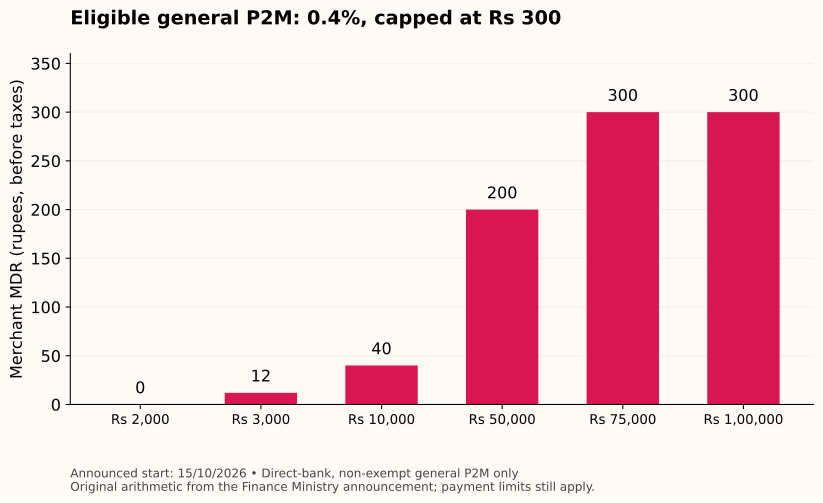
Original chart of illustrative general-category merchant MDR from 15/10/2026, before taxes. Exemptions and other categories are excluded; source: the Finance Ministry announcement linked above.
A hypothetical four-sale day
Assume four ordinary, eligible bank-account UPI merchant payments, with no small-merchant exemption or sector concession. These invented sales demonstrate the calculation; they are not observed transactions.
| Payment | Calculation | Estimated MDR |
|---|---|---|
| ₹1,950 | Within the zero-MDR band | ₹0 |
| ₹2,000 | At the protected boundary | ₹0 |
| ₹4,000 | ₹4,000 × 0.004 | ₹16 |
| ₹90,000 | Raw result ₹360; cap applies | ₹300 |
| Total: ₹97,950 | Add individual results | ₹316 |
Applying 0.4% to the combined ₹97,950 would produce ₹391.80. That misses both the small payments and the cap on the largest payment. A monthly sales total is therefore insufficient for this calculation; retain the individual payment amounts.
The ₹4,000 row also shows why subtracting ₹2,000 first is wrong. This is a transaction-size threshold, not a deductible allowance. Calculating 0.4% of only the remaining ₹2,000 would give ₹8 instead of ₹16. The official FAQ's worked examples in question 35 use the full eligible payment amount.
Choose the category before typing the amount
The general setting is useful only when its assumptions match. Check the P2PM small-merchant rule before modelling an exempt account. A qualifying essential-service payment uses a different structure. The capital-market tier has a different percentage.
Do not force a credit-funded, recurring or unidentified transaction into the general setting just to obtain a number. “Needs confirmation” is a useful result when the category is unknown.
Turn the estimate into a checkable record
Keep five columns: payment reference, amount, confirmed category, estimated MDR and actual fee shown by the provider. Add a separate note for any tax, adjustment or other charge identified on the statement.
If the estimate and statement differ, start with classification and the provider's explanation. Do not assume the difference is a tax, an error or a new fee. Preserve the individual reference so the bank can investigate the same transaction you calculated.
Use the total to plan payment costs, never as a reason to add an MDR surcharge to a customer's bill. The announcement places the charge on the merchant side.