A payment can feel free to the person sending it while still needing banks, software, security and customer support. The difficult question is who funds those services, and how the cost is shared.
The Finance Ministry describes MDR as revenue for payment-system participants, rather than a tax collected by the government or NPCI. Its September framework is scheduled from 15/10/2026, as confirmed in the official FAQ.
The RBI’s 2022 discussion paper, Box 9, illustrated roughly ₹2 of combined processing cost for an average ₹800 merchant payment. That is a dated, approximate cost illustration, not a ₹2 customer fee or a measured cost for every payment in 2026.
Read the denominator before sharing the percentage
“Approximately 96% unaffected” refers to person-to-merchant transaction count in the ministry's statement. It does not mean 96% of businesses are exempt, or that only 4% of rupees transferred are affected.
Hypothetical example: one shop receives 100 payments of ₹200 and two payments of ₹20,000. The two large payments are less than 2% of its payment count but two-thirds of its ₹60,000 receipts. That example is invented to explain denominators, not to reproduce the ministry's dataset or predict a shop's fees.
A chart of scale, not a fee forecast
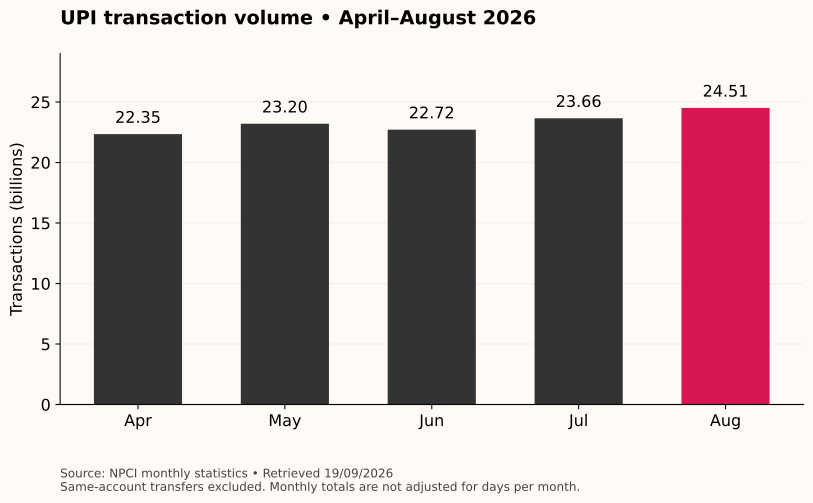
Original chart from NPCI monthly statistics, retrieved 19/09/2026. Volumes are converted from millions to billions and rounded to two decimals. NPCI excludes debit and credit to the same account.
August's total was 24,508.96 million transactions. The chart includes UPI overall; it is not a chart of payments that attract MDR. Monthly totals also reflect different numbers of calendar days. Growth by itself cannot calculate provider costs, prove a particular price is necessary, or predict merchant behaviour.
Will retail prices rise?
A2D Channel's Tamil video discusses the possibility of merchant costs feeding into prices. That is an economic argument, not a measured outcome of a framework that has yet to start.
A business may reconsider its overall costs and prices. Separately, the ministry says merchant MDR must not be passed to customers as a UPI charge. Do not turn either statement into a guarantee that every price will rise or that none ever can.
The announced support fund is described as receiving 5% of MDR collections. It is not a 5% levy on purchases, and an announced fund is not a grant a shop can already claim.
When checking the next viral chart, ask three questions: what is counted, over which period, and is the statement observed data or a forecast? That habit travels well beyond UPI.